Daily Ledger Skeletons
Sloane’s skeletons brought the crowds. The bridge hand nearly didn’t make it.
Across seven sites on Saturday night, people came to look at ten giant skeletal figures. Nearby businesses had to keep operating, stewards had to keep people moving, and one stubborn part of the river installation had already given its makers a week of trouble.
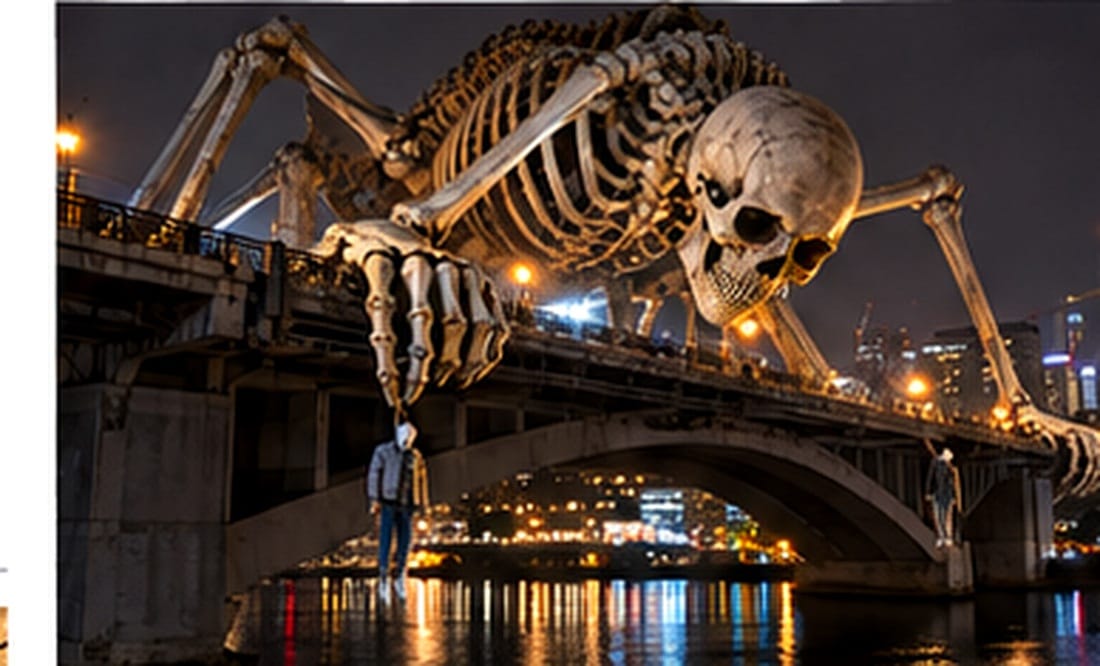
By 9:20 on Saturday night, the first problem on Crescent Bridge was not the enormous skeleton hanging above it. It was the people who had stopped under its hand.
They were taking photographs from the pedestrian side of the crossing, some looking upriver, others aiming their phones at the clothed figures hanging above the water. A steward asked a couple to move along so that the rest of the pavement could function as a pavement. They took one more picture and moved about three feet.
Farther along, a woman in a witch’s hat was trying to talk her friends into crossing the bridge a second time. “You haven’t seen the face from underneath,” she told them. One said he had. They went anyway.
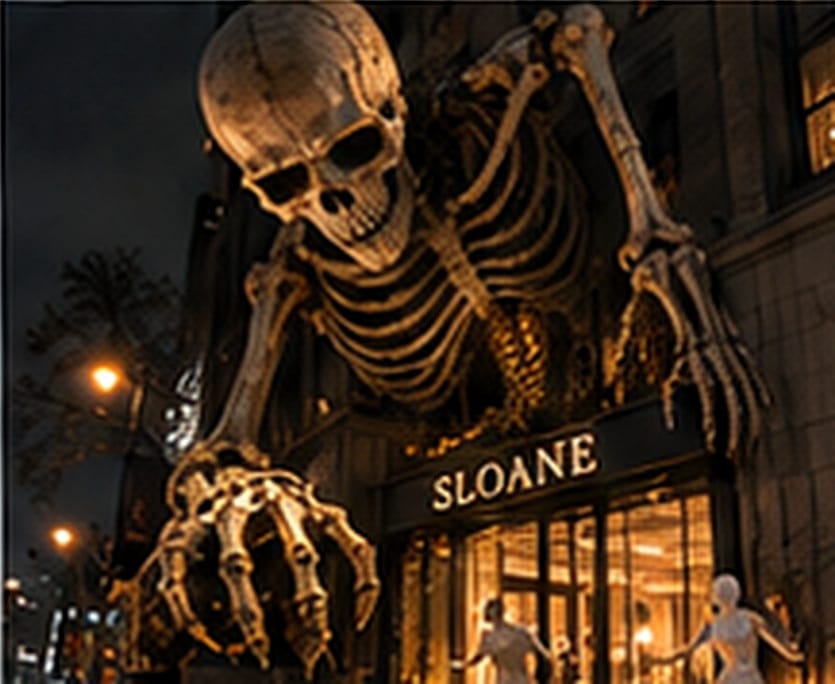
The bridge was one of seven places occupied over Halloween weekend by giant skeleton sculptures commissioned by The Miriam Sloane Endowment for Public Occurrence, better known simply as Sloane. In the central shopping district, another figure lifted a mannequin above a square; on the east side, two skeletons occupied a narrow street; in Lantern Square, three rose through mist and theatrical lighting. A figure above Exchange House appeared to be reaching out of the building itself.
The photographs make the scale clear, but not the noise: children shouting to their parents across the plaza, a passing driver leaning on the horn, somebody looking for a glove beneath a temporary barrier. At North Arcade, the smell of hot food from the shops persisted beneath the floodlights.
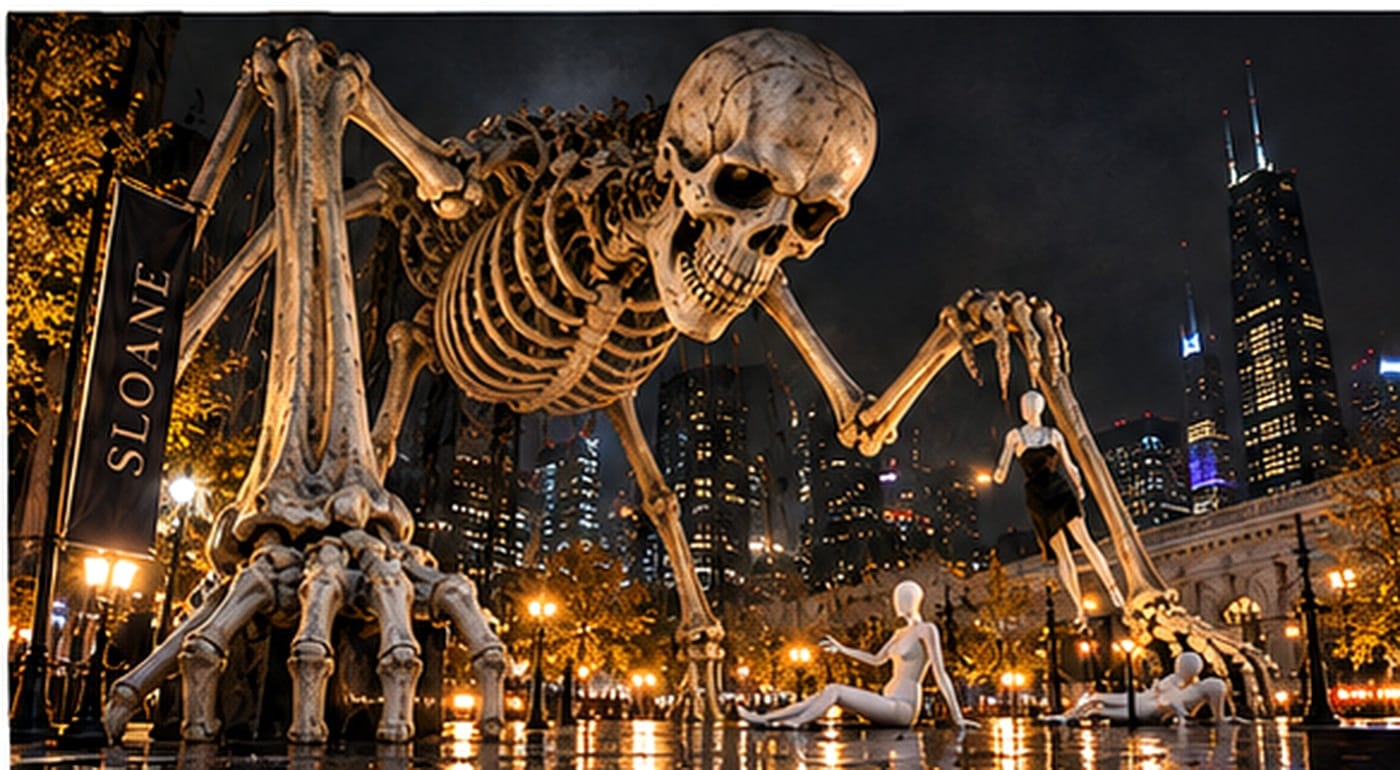
Elena Park had intended to collect noodles nearby and go home. She had not planned to visit an installation. “I saw the hand, then I stood there,” she said. “They were cold by the time I got back. It's all right. I ate them.”
The crowd nobody counted
At the busiest sites, stewards asked spectators to stop posing in building entrances and to leave the marked crossing spaces clear. When people encountered the installations on an ordinary errand, their routes sometimes became part of the evening’s choreography.
Salma Ortiz, who manages a food shop near the North Arcade piece, said the business was busier than a typical Saturday evening. “We ran out of drink lids at nine. I don't know what that tells you.” She was less cheerful about the photographs being taken directly in front of the door. “People keep putting their backs against it. It's a door.”
One visitor, Maren Bell, had taken her father to see the bridge scene after they found the plaza too crowded. “He kept asking which one was the biggest,” she said. “I don't know. I told him this one.”
The city has not published a total attendance figure. Asha Malik, who coordinated temporary pedestrian arrangements for the weekend, said head counts at particular cordons would not amount to an estimate for seven open sites. “We didn't count everyone who came through. I wouldn't use a number from one crossing as a crowd figure for the whole event.”
The public response was not uniformly delighted. Daniel Reed said his eight-year-old daughter refused to walk past the street-level mannequins at the Larch Street site. “She was happy with the big one,” he said. “It was the little ones she didn't like.” They went around the block.
At the bridge, the difficulty was a hand
For Ivo Marsh, Sloane’s fabrication lead, the part that caused the most trouble was not the enormous skull. It was the position of the bridge figure’s right hand, which needed to appear to clutch the railing without using the railing as its primary structural support.
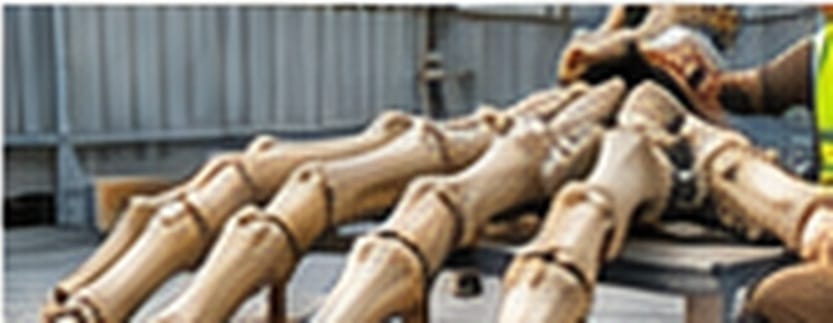
The first full-scale hand assembly worked in the workshop, Marsh said. Moving it was another matter. The long fingers and the angle of the wrist left too little room for the intended handling equipment on the bridge approach. The crew divided the palm and fingers into smaller units and revised the sequence of the lifts.
“We had a hand,” Marsh said. “We took it apart again. Then we had a hand in crates.”
The eventual solution involved a separate structural frame and a series of smaller connections assembled from temporary platforms, rather than a single dramatic lift. The decorative bones were made to read as one continuous limb after the bolted structure had been checked and the outer surface finished.
Public works deputy director Mara Kwan said the bridge had been considered separately from the street installations because of pedestrian access and the effect of temporary loads on existing infrastructure. “If it is attached to something permanent, we need to know what that thing is being asked to carry,” she said. “The approval did not cover whatever they happened to come up with on the day.”
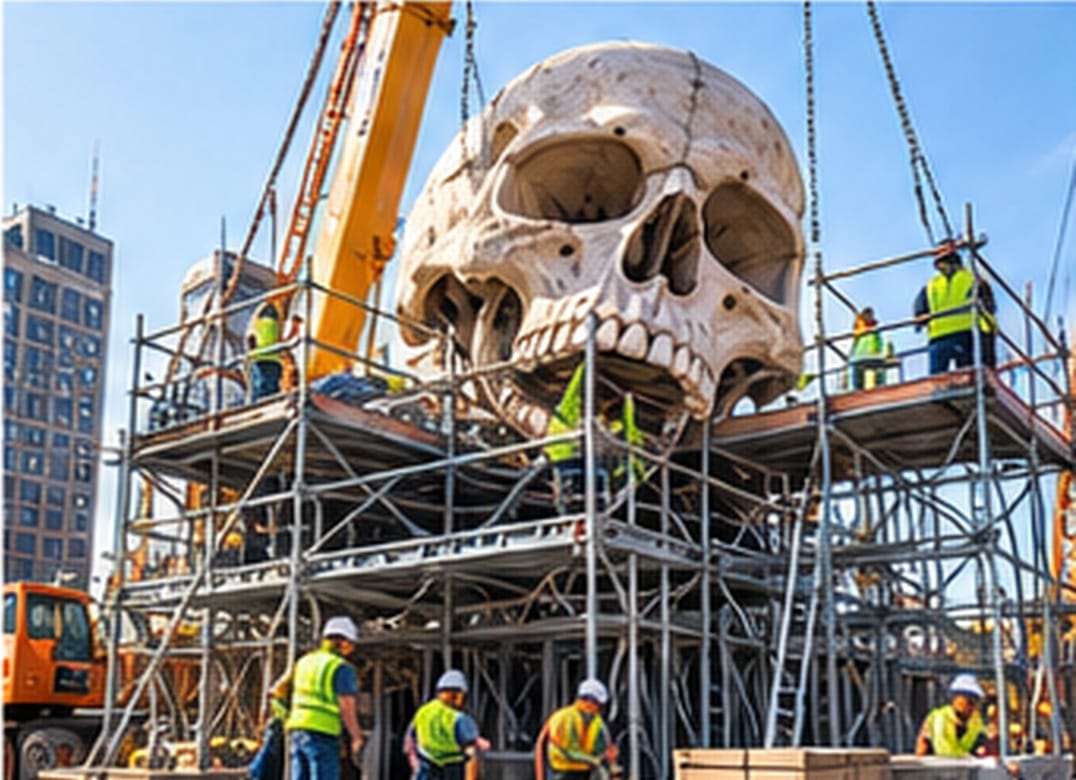
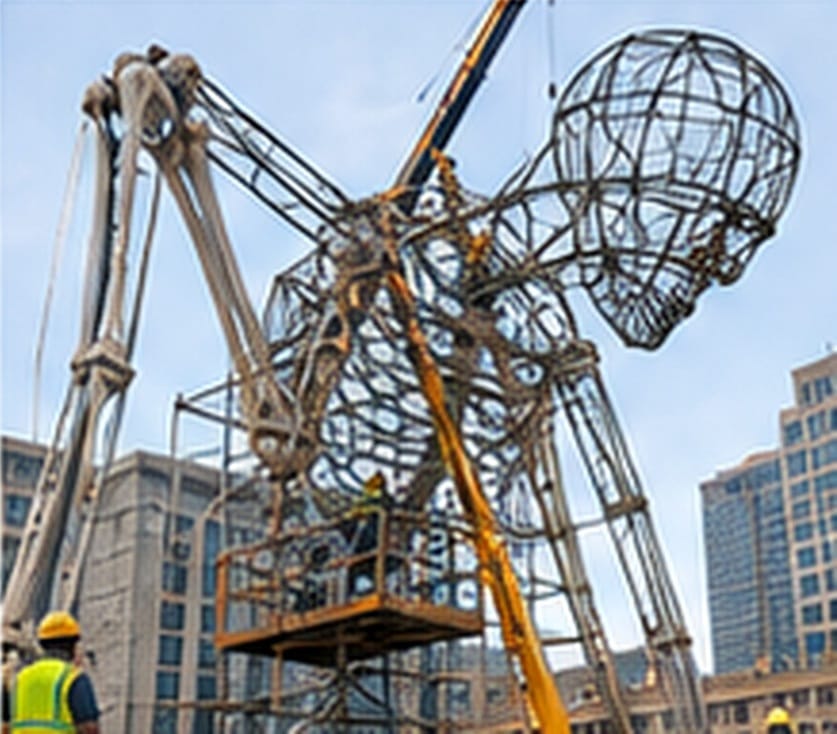
Photographs from the build show the same general method elsewhere: steel armatures lifted and braced in sections, composite bone panels attached over them, then joins filled and stained to make the figures look like weathered anatomical specimens. Skull pieces and hands arrived as separate assemblies. The contrast between the daytime workshop logic and the nighttime result is particularly pronounced at the plazas.
What went into the bones
Not all of the structures were assembled in the same way. Where a figure could stand over a ground-supported platform, workers used braced steel frameworks and temporary bases. The bridge and building-front pieces required other arrangements, tailored to their sites. Sloane’s technical crew said the sculptures were inspected as temporary structures, rather than treated as large seasonal decorations.
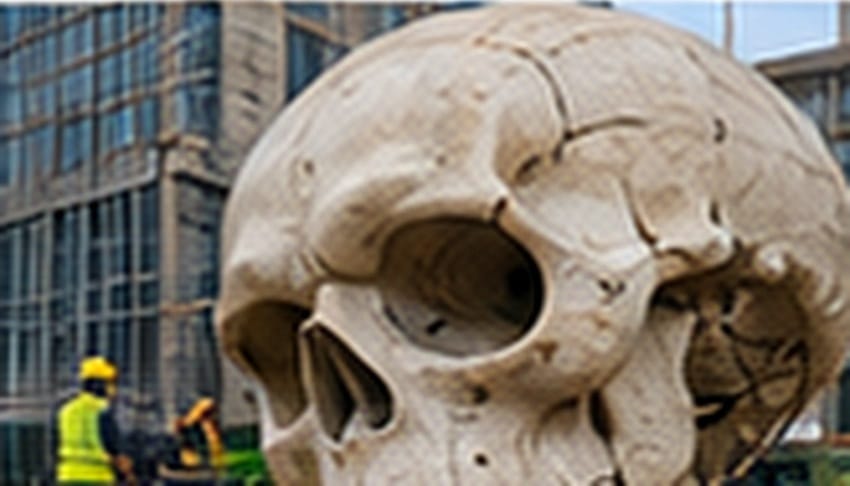
At Foundry Square, the open-mouthed crouching figure took shape inside scaffold towers. The ribs, shoulders and skull were worked on separately while crane operators positioned the larger sections. A completed skull lay at street level long enough for passersby to ask whether it was already the whole artwork.
Marsh said the surface had to be light enough to install without defeating the engineering below it and convincing enough to withstand spectators seeing it from a few feet away. “You spend a lot of time on a joint people will never see,” he said. “Then someone stands there and photographs the side where the paint didn't quite match.”
Lighting crews returned after the assembly checks. The warm lamps brought out cracks and staining in the shell; the rain supplied the reflections, at no extra charge.
Who gets the pavement?
The installations came with the now-familiar practical questions attached to a Sloane event. Its Games, Suspended Living Room and earlier stair-only monument helped establish an expectation that an everyday route might temporarily accommodate something that does not serve a conventional purpose.
The arrangements still had consequences for daily travel. One wheelchair user, Priya Desai, said the diversion near North Arcade was marked but placed the best viewing angle on the far side of a busy crossing. “I got a picture,” she said. “It's a good picture. I couldn't get to where everybody else was standing.”
Malik said stewards moved sections of the temporary crowd line as the evening progressed and that the city would review access complaints when the installations came down. She did not claim that all seven sites had worked equally well. “Some were better than others,” she said. “We'll need to go through the reports.”
The Miriam Sloane Endowment for Public Occurrence finances the works in full, including fabrication, crews, closures, inspections, city coordination, dismantling and restoration. It has not provided a public itemisation of that expenditure. Leila Renn, Sloane’s director of public installations, said the organization would release a programme summary but did not give a date for a detailed cost statement.
Asked why the works were spread across ordinary streets rather than confined to one ticketed site, Renn said the locations were part of the commission. “We could have put them all behind a gate,” she said. “It would have been a different thing.”
Seven scenes, across the streets
The work was dispersed, not presented as one continuous exhibition. The Ledger identified the following sites and scenes during the weekend; exact viewing arrangements may change during removal.
A skeleton stretched over the span; mannequins hung above the river.
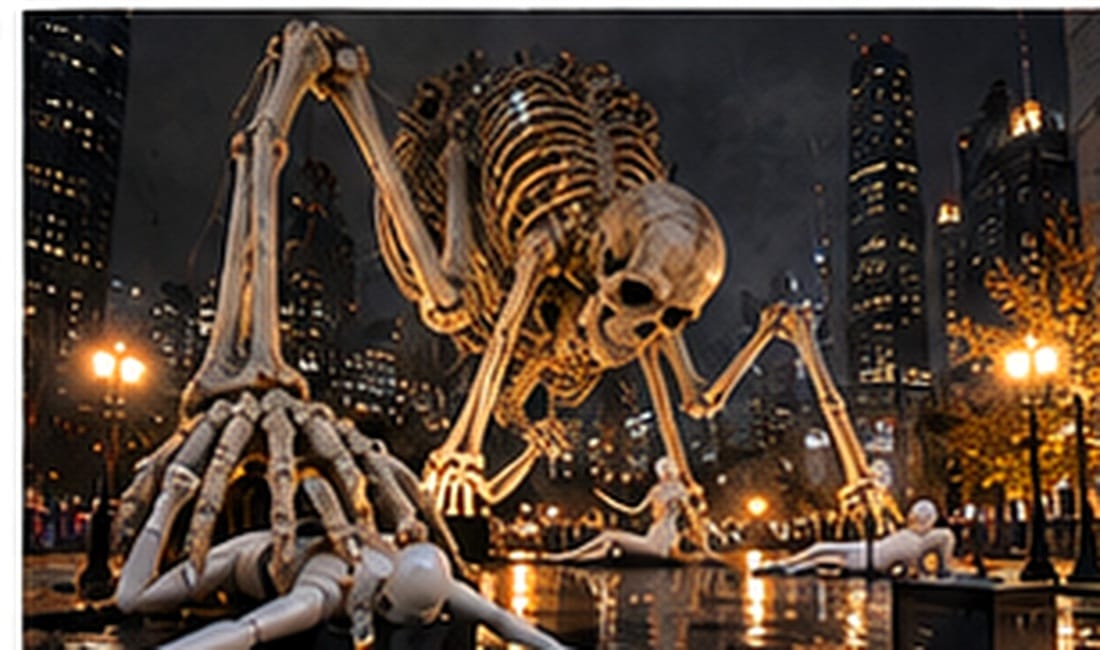
The open-jawed, spider-like crouching figure over the plaza.
A giant crouched above mannequins on a commercial street.
An illuminated figure holding a mannequin overhead, with others at its feet.
A pair of skeletal figures in a narrow wet street.
Three enormous figures across a misty public square.
A giant figure apparently emerging from the upper storeys and reaching toward the pavement.
After the last photograph
Sloane says crews will remove the mannequins and lighting before taking the structural elements apart. There is no published confirmation that any complete scene will return next Halloween. Some modules may be kept for future work, but Renn would not say which.
Late on Saturday, after a steward had finally persuaded a group to leave the bridge hand clear, two people came back the other way. One was looking down, checking the photographs she had taken. The other was looking up at the skeleton again. They walked past the steward without stopping.
How this story was reported: The Ledger visited multiple sites on Saturday evening and reviewed daytime construction photographs and the Endowment’s account of assembly. The city did not supply an overall audience estimate. We have asked Sloane for an itemised budget and the city for the final access and inspection summaries.
Further records: Endowment programme · Construction approvals · Temporary street orders · Access arrangements · Corrections and clarifications.